
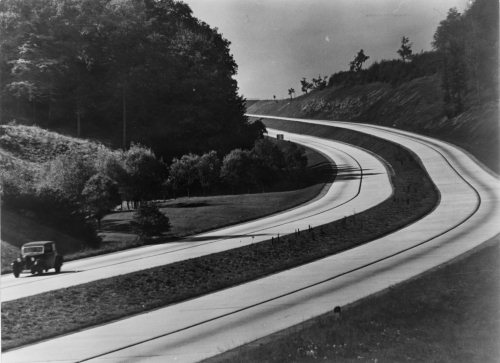
Pavement in American motorways are typically made with low initial construction cost, but with ongoing and pricy maintenance. This differs severely from the European and namely German building philosophy. The plans for the Autobahn originated in the 1920'ies under the Weimar Republic. An increasing number of vehicles began to appear all around the country, as the wounds and damages after the devastating world war began to heal. The economy was beginning to flourish again, and despite a recent hyperinflation the country was entering what would later be known as the "golden years" of the republic.
Ideas for express carriageways only for motor vehicles were already present at the time, as in Italy where the first part of the "autostrada" was completed in 1924. In Weimar the vision for the first part of what would later become the Autobahn was the stretch from Hamburg over Frankfurt to Basel. On November 6, 1926 a association called HaFraBa (short name for the involved cities) was founded. A huge project at the time (with a span of over 800 kilometers), it would require intensive engineering and labour power. However, due to the loss of the 1st world war, Germany was unable to lend money anywhere, and secondly the railway industry lobbied against such a proposal. The solution was to collect road tolls, just like Italy did for their projects.
When the Third Reich swept away the slowly collapsing republic, the plans for the HaFraBa was initially rejected, but with the rise of Adolf Hitler things changed. He formed a vision; a plan for the Reichsautobahn. Just as the railways had played an important part in modernizing infrastructure, the time was ready for the motorways to do the same. Thus, in 1933 a law was passed, and the association Gesellschaft Reichsautobahnen created to surpass the construction of this immense project, and the first dig was done by Adolf Hitler himself on September 23 that same year.
This was the beginning of one of the world most well respected and sturdy road networks in the world: Autobahn.
When the Third Reich swept away the slowly collapsing republic, the plans for the HaFraBa was initially rejected, but with the rise of Adolf Hitler things changed. He formed a vision; a plan for the Reichsautobahn. Just as the railways had played an important part in modernizing infrastructure, the time was ready for the motorways to do the same. Thus, in 1933 a law was passed, and the association Gesellschaft Reichsautobahnen created to surpass the construction of this immense project, and the first dig was done by Adolf Hitler himself on September 23 that same year.
This was the beginning of one of the world most well respected and sturdy road networks in the world: Autobahn.
Map of the the first Autobahn stretch, Hamburg over Frankfurt to Basel

