Showing posts with label Germany. Show all posts

Wednesday, 1 January 2014

Autobahn


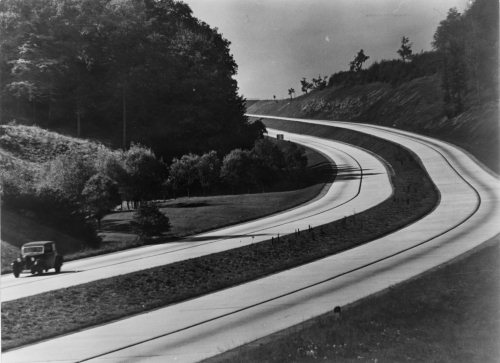
Pavement in American motorways are typically made with low initial construction cost, but with ongoing and pricy maintenance. This differs severely from the European and namely German building philosophy. The plans for the Autobahn originated in the 1920'ies under the Weimar Republic. An increasing number of vehicles began to appear all around the country, as the wounds and damages after the devastating world war began to heal. The economy was beginning to flourish again, and despite a recent hyperinflation the country was entering what would later be known as the "golden years" of the republic.

Ideas for express carriageways only for motor vehicles were already present at the time, as in Italy where the first part of the "autostrada" was completed in 1924. In Weimar the vision for the first part of what would later become the Autobahn was the stretch from Hamburg over Frankfurt to Basel. On November 6, 1926 a association called HaFraBa (short name for the involved cities) was founded. A huge project at the time (with a span of over 800 kilometers), it would require intensive engineering and labour power. However, due to the loss of the 1st world war, Germany was unable to lend money anywhere, and secondly the railway industry lobbied against such a proposal. The solution was to collect road tolls, just like Italy did for their projects.

When the Third Reich swept away the slowly collapsing republic, the plans for the HaFraBa was initially rejected, but with the rise of Adolf Hitler things changed. He formed a vision; a plan for the Reichsautobahn. Just as the railways had played an important part in modernizing infrastructure, the time was ready for the motorways to do the same. Thus, in 1933 a law was passed, and the association Gesellschaft Reichsautobahnen created to surpass the construction of this immense project, and the first dig was done by Adolf Hitler himself on September 23 that same year.

This was the beginning of one of the world most well respected and sturdy road networks in the world: Autobahn.


Map of the the first Autobahn stretch, Hamburg over Frankfurt to Basel

Friday, 19 August 2011

Mauerwerk

"On August 13, 1961, at 1.14 am, passengers of the S-Bahn train at busy Friedrichstrasse station heard an announcement ordering them to deboard the train, as continuation of the trip from one sector to the other would no longer be possible."


"TOR IM LICHT", a Creative Commons Attribution (2.0) image from m.joedicke's photostream 


August 13, 1961. A great wall arises in the center of Berlin, the former Reichstadt of Hitler's empire. From day to day, a whole city was divided. Just as the capital of the former militant Germany was recovering from the devastating world war, it was weakened even further. The wall proved GDR's reign in a very physical way, and truly visualized a certain man's old idea of a parted Europe:

"From Stettin in the Baltic to Trieste in the Adriatic, an iron curtain has descended across the Continent. Behind that line lie all the capitals of the ancient states of Central and Eastern Europe. Warsaw, Berlin, Prague, Vienna, Budapest, Belgrade, Bucharest and Sofia, all these famous cities and the populations around them lie in what I must call the Soviet sphere, and all are subject in one form or another, not only to Soviet influence but to a very high and, in many cases, increasing measure of control from Moscow." 
- Winston Churchill, 1946

With a brand new "anti-facist protection rampart" the GDR was ready to outlive their vision of communism. It resulted in a totalitarian state, completely isolated from its surroundings controlled by the "Sozialistische Einheitspartei Deutschlands", the state's single political party. Their reign proved to be fatal to East Germany, as the inhabitants were under heavy surveillance; people who were suspected of being political deviants were persecuted by the Stasi, the state security police. An outrageous number of people were working for Stasi, finding "enemies of the state"; opening letters, spying on private homes, tapping phones etc. East Germany is obsolete today and has been so for many years, but many signs of the past is still visible in Berlin. The city oozes of history's whirr of wings, with reminisces of many eras, changes and differences - all strongly connected to Europe's development.

50 years after the construction of the wall one could try to imagine the situation on a late summer many years ago. People, roads, buildings, cultures, friends and foes were split apart by a mere geographical border. From one day to another, a divided world. Twenty years after the same wall fell to the velvet revolution in 1989, Berlin and Germany stands strong again. Rebuilding and nourishing a war-worn country and city, creating new ideals and values for a modern country. Despite the successful recovery, Germany has just only recently finished paying off their debt from WWI - a proof of how this country's 'leben' is so deeply rooted in wars, revolutions and history.

Tuesday, 2 August 2011

Post-war Dreams

The fact that the term "post-war era"could easily be associated with another period than that of 1945 and beyond, is a great testimony of the turbulent and ideological-willing times of Germany and the whole of continental Europe during most of the twentieth century. Countries and old beliefs were swept aside under the reign of wars, dictators and ideologies who would seek out to take over or destroy any resistance on its way - be it with either flags or caterpillar tracks.

During all these periods, especially after first World War, some anti-war forces wanted to make not only an attack on the people who had started the war in the first place, but an attack on the thinking of warfare itself. A man who believed that warfare rose ethical and philosophical dilemmas was German WWI veteran Erich Maria Remarque. He was the man who, in 1929, wrote the original novel to the much better known Hollywoodian war epic production: "All Quiet on the Western Front". The 1930 film had typical features of early film making; a nowadays very excessive symbolism and moralism of how meaningless and "sad" the war was which didn't leave a lot for the viewer to interpret. But at the same time it provided a deep psychological aspect of the war's impact on those involved; the post-traumatic stress and deep despair of the loss of their friends - and foes. This happens as a young German soldier stabs a French opponent with his bayonet during an attack. The French soldier does not die instantly from his wound, and the young soldier is mortified by what he has done and realizes that he probably has a family waiting for him at home as well. Remarque wants to show us that a German or French soldier are equally human and that the war propaganda produced by different factions were nothing but lies.

A frame from the 1930 film "All Quiet on the Western Front"
who won two Oscars for Best Picture and Best Director


The start of the film shows how a teacher stirs up his students to enroll as volunteers in the War and, as the teacher says himself, to lead the young and bright boys into war. This shows us how belligerent and irresponsible the conservative aristocracy, with their position of power, had glorified the war and deceived generations of naive young men. And as Herbert Hoover famously once said: "Older men declare war, but it is the youth that must fight and die."

All in all the film is a modest attempt to show what war does to people and furthermore, to "post"-rationalize first World War to convince its audience that mankind would not benefit from such a matter once again. But despite all efforts it did happen again.

Not long after Hitler's inauguration the 30th of January 1933, when NSDAP became the only legal party in Germany, "All Quiet on the Western Front" and the rest of his works were banned as Joseph Goebbels through propaganda claimed Remarque was: "a descendant of French Jews and that his real last name was Kramer".

Remarque joins the list of German "Exillitteratur"- writers who fled from Germany in that period to seek shelter from prosecution or harassment from the state.

Thursday, 21 April 2011

War

In late 1918 the German empire lied in ruins following the devastating "Great War" leaving behind a tragic scenery for the remains of the European peoples whose young generations had fought and died on the battlefields of Somme, Tannenberg, and Ypres. A gaping hole of emptiness was created due to the meaningless of mankind and its endless brutality who had killed a whole generation of painters and poets, young and old.


The German people demanded an explanation for why millions of German husbands, brothers, and fathers had fallen in battle - a battle that never crossed the german borders. Riots broke out in the cities, and all over Germany workers attempted a revolution very much like the one in Russia. The people never really experienced the horrors of war and therefore, couldn't understand why Germany had lost and wished for someone to pay the prize of surrendering - this came, amongst others, to be the old German Empire and its emperor; now it was time for a new and free Germany, now it was time for the Weimar Constitution.

The Weimar Constitution was founded in the city of Weimar in the Land of Thüringen. This constitution was forged by the new ideas of liberalism and created a radical clash between the old German empire and a new democratic Germany. Shaped by the spirit of the two German thinkers Goethe and Schiller, the constitution attempts to protect the freedom of speech and other essential rights thus trying to create a country where individualism and pluralism thrived.

The newly gained freedom of the German people with its liberal ideas and the cruel memories of First World War provided a postwar atmosphere that had both elements of absurdity, meaninglessness, creativity, and a revolutionary spirit.

This "Zeitgeist" of believes and historical background was to create an artscene more critical of society and politicly involved than before. The golden twenties of art and film had begun.